

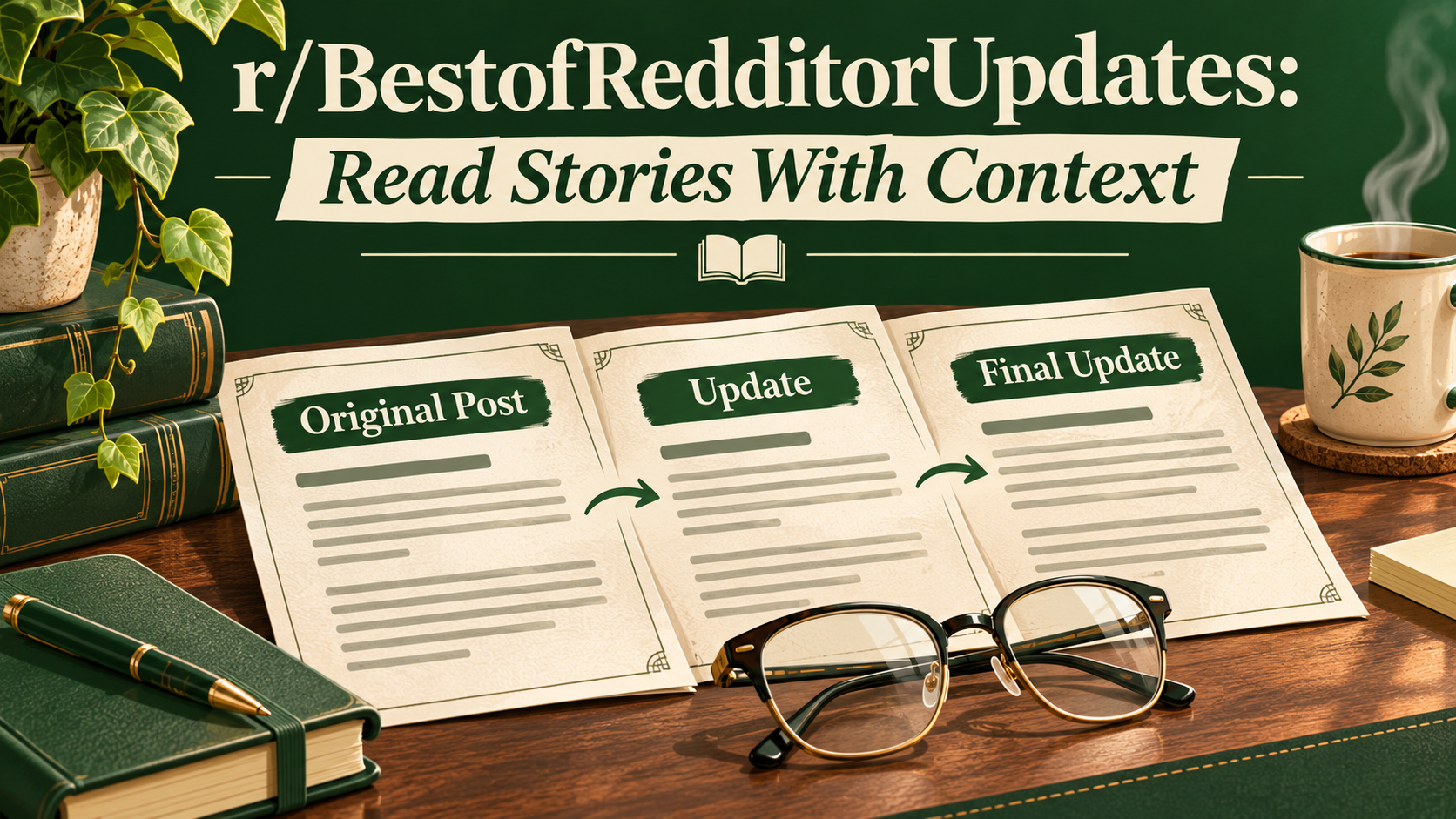
r/BestofRedditorUpdates collects Reddit posts and later updates so readers can follow how a reported situation developed. A readable compilation helps organise a story, but it does not independently verify everything its original writer says happened.
That distinction matters because a chronological account can feel more complete than the available evidence really is. This guide explains how to read the timeline, distinguish the compiler from the original poster and discuss a story without turning an incomplete personal account into a universal lesson about other people's lives.
Understand the Format of r/BestofRedditorUpdates
The r/BestofRedditorUpdates community page presents compilations that identify original posts and subsequent updates. The person assembling the material may not be the person whose experience is described. Read the introduction and attribution before assuming that the account publishing the compilation can answer questions about the events.
The abbreviation OOP commonly refers to the original poster in this setting. A compiler may quote the OOP, add contextual notes and include selected comments. Each layer has a different role. Keeping those roles separate helps you avoid attributing an editorial note or another reader's suggestion to the person describing the situation.
Read the Dates Before Judging the Outcome
Notice the date of the original post, the dates of updates and the date of the compilation. They answer different questions. An update published much later can change the account, while a newly posted compilation may describe events that are already several years old.
Build a simple sequence in your mind: initial situation, information available at that point, later development and latest reported position. Avoid using information from the final update to judge what a person should have known at the beginning. Hindsight can make an uncertain decision appear much simpler than it was in the account being presented.
If a date is missing or contradictory, preserve that uncertainty. Do not fill the gap with a guessed sequence just because it produces a cleaner story. A useful comment can identify the ambiguity and explain how different timings would affect your interpretation without claiming to resolve it.
Separate Reported Events From Interpretation
A writer may report an action and then explain what they believe motivated it. Those statements are related, but they are not identical. A person can describe receiving a message while remaining uncertain why the sender wrote it. Readers should not silently convert the writer's interpretation into an independently established motive.
Consider an invented example: a narrator says a friend cancelled a meeting and concludes that the friendship is ending. The cancellation is the event described; the conclusion is an interpretation. A later update might support or challenge that interpretation. This example illustrates a reading method and is not a summary of a real community post.
Our guide to r/SquaredCircle discussion also distinguishes an observation from a larger explanation. With personal accounts, that care is especially useful because readers usually have access to only the material one participant chose to share.
Treat a Clear Ending as a Narrative Feature
A story can end neatly on the page while the lives involved continue beyond it. A final update may establish only that the original writer stopped posting. It does not prove that every consequence is settled or that other participants would describe the situation in the same way.
Read status labels in the context of the community's current definitions. Do not interpret them as a guarantee that the underlying events have been investigated. A compilation can accurately present the available posts while leaving the truth of the wider story unconfirmed. Those are different standards of completeness.
This does not require dismissing every account as fiction. It means matching your confidence to the evidence. You can find a story moving, discuss the choices it describes and still acknowledge that you do not have independent access to the people or events involved.
Recognise the Limits of Comment Consensus
Many comments reaching the same conclusion do not create new evidence if they rely on the same account. Agreement can show how participating readers interpret the story, but it cannot establish a diagnosis, a legal outcome or the private motives of someone who has not provided their perspective.
Ask whether a reply adds a relevant source, identifies an overlooked detail or merely repeats a popular interpretation. The last kind can express solidarity or frustration, but it should not be mistaken for corroboration. Read the reasoning rather than counting the number of similar reactions.
Our article on reading political discussion with context explores a related distinction between a claim and the response it receives. In both settings, repeated confidence should prompt a look at the underlying evidence rather than replace it.
Discuss the Story Without Contacting Its Participants
The community's participation guidelines set boundaries for discussing compilations and their contributors. The community page also warns readers against commenting on linked posts. Respect those boundaries rather than treating a compelling story as an invitation to intervene.
Do not search for workplaces, relatives or personal accounts to identify the people involved. A detail may have been altered or omitted, and a confident identification can harm somebody unrelated to the story. Discussion does not need an amateur investigation into private individuals to remain thoughtful.
Reddit's platform rules include expectations around privacy and respectful participation. When a story raises a serious real-world issue, distinguish general discussion from case-specific professional advice. An anonymous account does not provide all the facts needed to decide another person's legal or medical situation.
Use a Better Set of Reading Questions
Ask what changed between updates, which facts were available to the narrator and where uncertainty remains. These questions lead to a richer discussion than deciding immediately which person deserves the harshest label. They encourage readers to follow the account rather than impose a familiar plot on it.
Also ask what evidence would change your reading. If no possible detail could alter your conclusion, you may be responding more to a recognisable theme than to this particular account. That awareness does not invalidate your feelings. It helps separate your personal associations from the information the compilation actually supplies.
Finally, notice when a story is no longer useful for you to read. You can stop without reaching a verdict or writing a reply. The ability to leave uncertainty unresolved is part of reading responsibly, particularly when the material concerns people whose experiences you cannot independently check.
Notice How Selection Shapes the Account
A compilation necessarily directs attention: it chooses an opening, a sequence and particular supporting comments. Those choices can improve readability while still leaving out parts of the original discussion. Ask whether a quoted response supplies new information or mainly reinforces an emotional reading already suggested by the story.
This does not mean a compiler has acted unfairly whenever material is omitted. A readable post cannot reproduce every surrounding exchange. It means readers should recognise that an organised account is also an edited presentation. If a conclusion depends heavily on an excerpt, inspect its attribution and available context before treating it as decisive. Keep the difference between useful organisation and independent verification visible throughout your reading.
Frequently Asked Questions
Is the Compiler Usually the Original Poster?
Not necessarily. Read the attribution at the start of the compilation and the labels attached to quoted material. The compiler organises the account, while the original poster describes the experience. Confusing those roles can distort both the story and the discussion.
Are All Stories Independently Verified?
A compilation is not by itself an independent investigation. Evaluate what the linked material establishes and what remains an assertion by its writer. Neither a detailed timeline nor a popular response guarantees that every event has been confirmed.
Why Are Dates So Important?
Dates reveal what the writer knew at each stage and how much time passed between developments. They also prevent an old story from being mistaken for a current event. Read the event sequence before judging decisions through the final outcome.
Does a Concluded Label Guarantee Closure?
Read the community's current label definitions, but do not treat a narrative status as proof that every real-world consequence is settled. The available posting sequence may have ended while information outside the account remains unknown.
Should I Contact Someone to Ask What Happened Next?
Respect the community's no-interference boundaries and do not contact story participants or comment on linked posts because of a compilation. Discuss the available material in the appropriate place without turning curiosity into unwanted attention.

1 Comment
Pingback: r/LAinfluencersnark: Reading Claims Carefully