

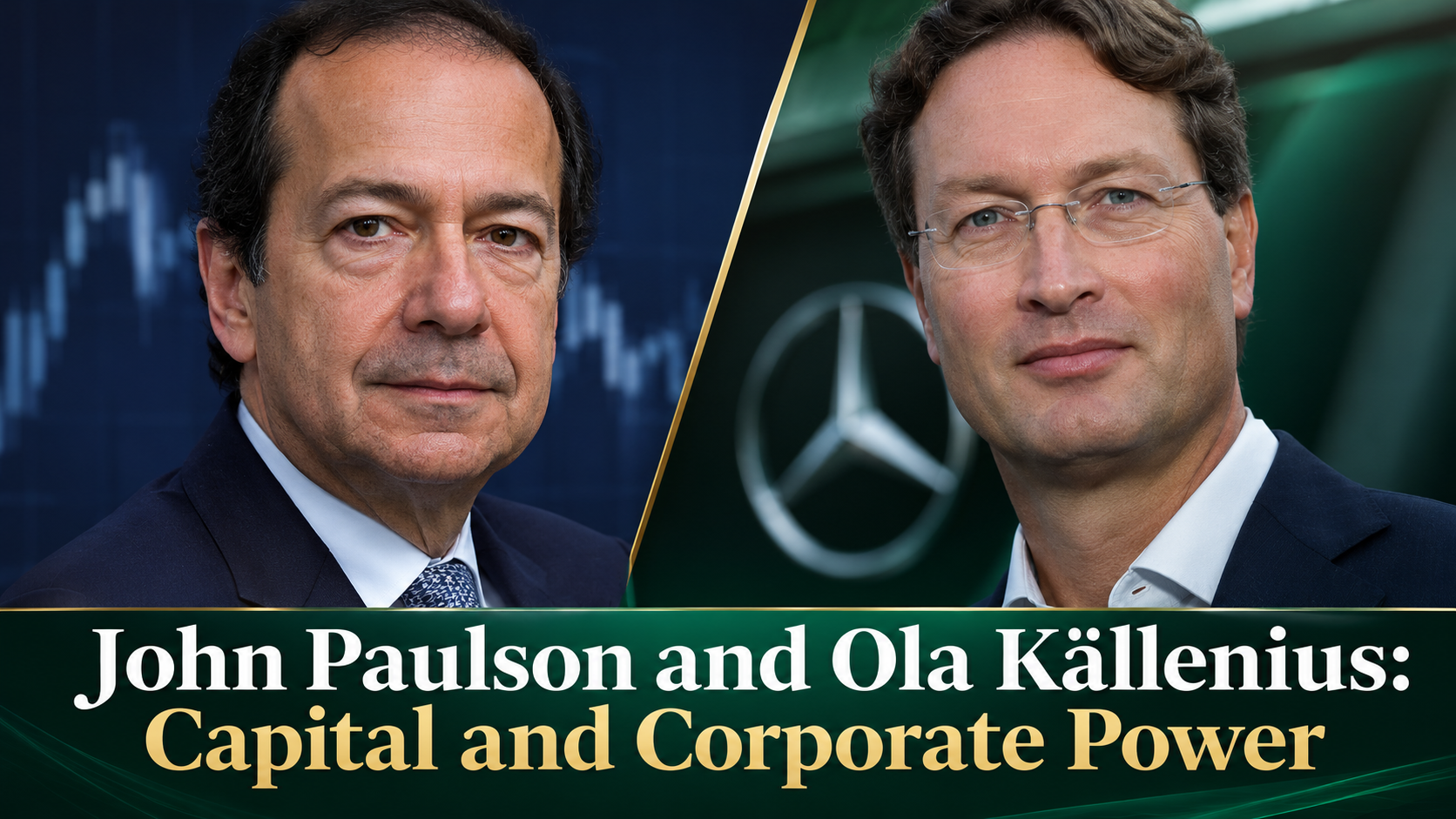
John Paulson and Ola Källenius represent different forms of economic influence: Paulson is an investment manager associated with Paulson & Co., while Källenius leads Mercedes-Benz Group. Their careers can be compared through capital allocation, institutional responsibility and the evidence used to assess a decision. The sources reviewed here do not establish a joint venture or personal connection between them.
The distinction matters because investors and corporate executives are often described with the same broad language of wealth and power. In practice, their authority comes from different arrangements. An investment decision concerns the use of capital under a particular mandate; an operating-company decision involves products, employees, customers and an organisation’s continuing commitments.
John Paulson and Ola Källenius: where their authority comes from
Paulson’s public identity is tied to investment management and philanthropy. Källenius’s is tied to a corporate appointment and a career in automotive management. These are starting points for analysis, not shorthand for personal control over every asset associated with their names. A fund, a university endowment and an automotive group each have their own legal and institutional arrangements.
To understand a financial headline, identify who owns the money, who makes decisions and who carries the consequences. These may be different parties. The person speaking publicly may be an executive, a founder, a portfolio manager or a donor. Each description implies different responsibilities, and none can be substituted for the others without checking the underlying facts.
A documented Paulson milestone: the Harvard gift
Harvard’s 2015 announcement of John Paulson’s gift records a $400 million endowment for its School of Engineering and Applied Sciences. The university described it as its largest gift at that time. The date is important: a historical announcement should not be presented as a newly made donation.
The gift provides a concrete example of capital moving into a long-term institution. An endowment is intended to support activity beyond a single purchase or annual campaign. In this case, the recipient and purpose are documented by the university itself. Those details make the gift a stronger basis for discussion than a vague claim that a wealthy person “supports innovation”.
However, a donation is not a complete account of the donor’s finances. It shows a particular commitment, not all assets, debts, investments or future obligations. Nor does a naming association mean that the donor personally directs every academic decision. Responsible coverage keeps the verified gift separate from assumptions about institutional control or the entirety of a person’s fortune.
What philanthropy can reveal about time horizons
Funding education can involve a different time horizon from a financial trade. Research, teaching and the development of new expertise may produce benefits that cannot be reduced to a quick commercial return. That does not make outcomes unimportant. It means the relevant questions concern the institution’s purpose, the use of funds and the durability of support.
A reader can therefore ask what was funded, when it was announced and how the recipient describes the commitment. These questions are more useful than using the donation as an automatic endorsement of every investment associated with the donor. Philanthropic activity and investment performance are separate subjects, even when they involve the same public figure.
Källenius and the obligations of an operating business
Mercedes-Benz’s official management biography records Källenius’s appointment as chairman of its management board from May 2019. It also places that appointment within a longer management career. The record establishes his role; it does not make the group’s revenue or assets equivalent to his personal property.
Automotive leadership requires decisions about physical products that remain in use after a sale. Engineering, production capacity, software support, service networks and supplier relationships all contribute to the customer’s experience. Capital allocation in that setting is connected to an operating system. The cost of a decision can include consequences for employees and customers as well as shareholders.
This makes the timing of evaluation important. A development programme may take years, and a vehicle’s reliability can only be understood through use over time. Short-term financial reporting is relevant, but it is not the whole record. A balanced assessment considers whether the company’s investments produce useful products and sustainable operating results, while distinguishing management intentions from completed outcomes.
Investing in a company and running one are different jobs
An investor can decide whether a particular exposure fits a portfolio. An operating executive has to decide how the business will deliver its goods or services. The two perspectives overlap, especially when both consider future cash flows and risk, but they are not identical. An attractive investment thesis does not supply a factory schedule or solve a product-quality problem.
Equally, a well-liked product does not automatically establish that a company’s shares are attractively priced. Price, expectations, liabilities and future performance matter to an investment assessment. This is a general analytical distinction, not a recommendation about a fund or a security. The comparison helps explain why praise for a business and an investment decision can legitimately point in different directions.
Both roles involve uncertainty. A portfolio manager cannot know every future market movement; a corporate executive cannot remove every commercial risk. The meaningful question is how decisions are made with incomplete information, what assumptions are stated and whether later evidence supports them. Confidence in a public presentation is not the same as certainty about the future.
The financial figures readers should keep separate
Assets under management describe assets a manager oversees under a stated definition. They do not automatically belong to the manager. Company revenue describes sales over a period, not the chief executive’s earnings. A donation describes a transfer or commitment, not a complete net-worth statement. These distinctions prevent common errors in business and celebrity comparisons.
Executive remuneration has its own complications. A reported package may include salary, incentives and share-related awards, with different timing and valuation rules. Comparing its headline total with a private investment fortune can be misleading unless the definitions are explained. A precise-looking table is not useful if its numbers measure different things.
This article does not assign a personal wealth ranking to Paulson and Källenius. The accessible institutional records support a discussion of professional roles and specific historical events. They do not provide a full, independently verified balance sheet for both individuals. Leaving that limit clear is more informative than presenting an unsupported estimate as settled fact.
How to evaluate a capital-allocation story
Begin by separating the announcement from the result. An announced investment describes a plan or commitment; later records help establish what was completed and what it achieved. Identify the decision-maker, the institution, the amount where verified, and the relevant date. Then ask which outcome would actually demonstrate success in that setting.
Source quality matters throughout that process. BlogAngles’ article on assessing commercial-review evidence and its Boltyforts.com reading guide offer related context about checking online claims. Neither is evidence of a Paulson or Mercedes-Benz relationship; they are additional resources for readers evaluating business information.
Frequently asked questions
Are John Paulson and Ola Källenius business partners?
The sources reviewed here do not establish a joint business venture. This article compares their separate documented roles and does not imply a partnership.
How much did John Paulson give Harvard in 2015?
Harvard announced a $400 million endowment for its School of Engineering and Applied Sciences. That is a dated institutional record, not a current estimate of Paulson’s wealth.
Does an investment manager own all assets under management?
No. Managed assets can include money belonging to clients or other investors. The figure must be read according to the reporting entity’s definition.
Does Mercedes-Benz revenue belong to its chief executive?
No. Corporate revenue and an executive’s personal compensation are separate financial categories. The company also has operating costs, liabilities and shareholder interests.
What is the most useful comparison between these two figures?
The clearest comparison concerns how capital is directed and how responsibility differs between investment management, philanthropy and operating-company leadership. It avoids treating every financial headline as a personal wealth figure.

2 Comments
Pingback: Morgan Freeman and John Paulson Net Worth Comparison
Pingback: Bob Dylan and John Paulson Net Worth Comparison