

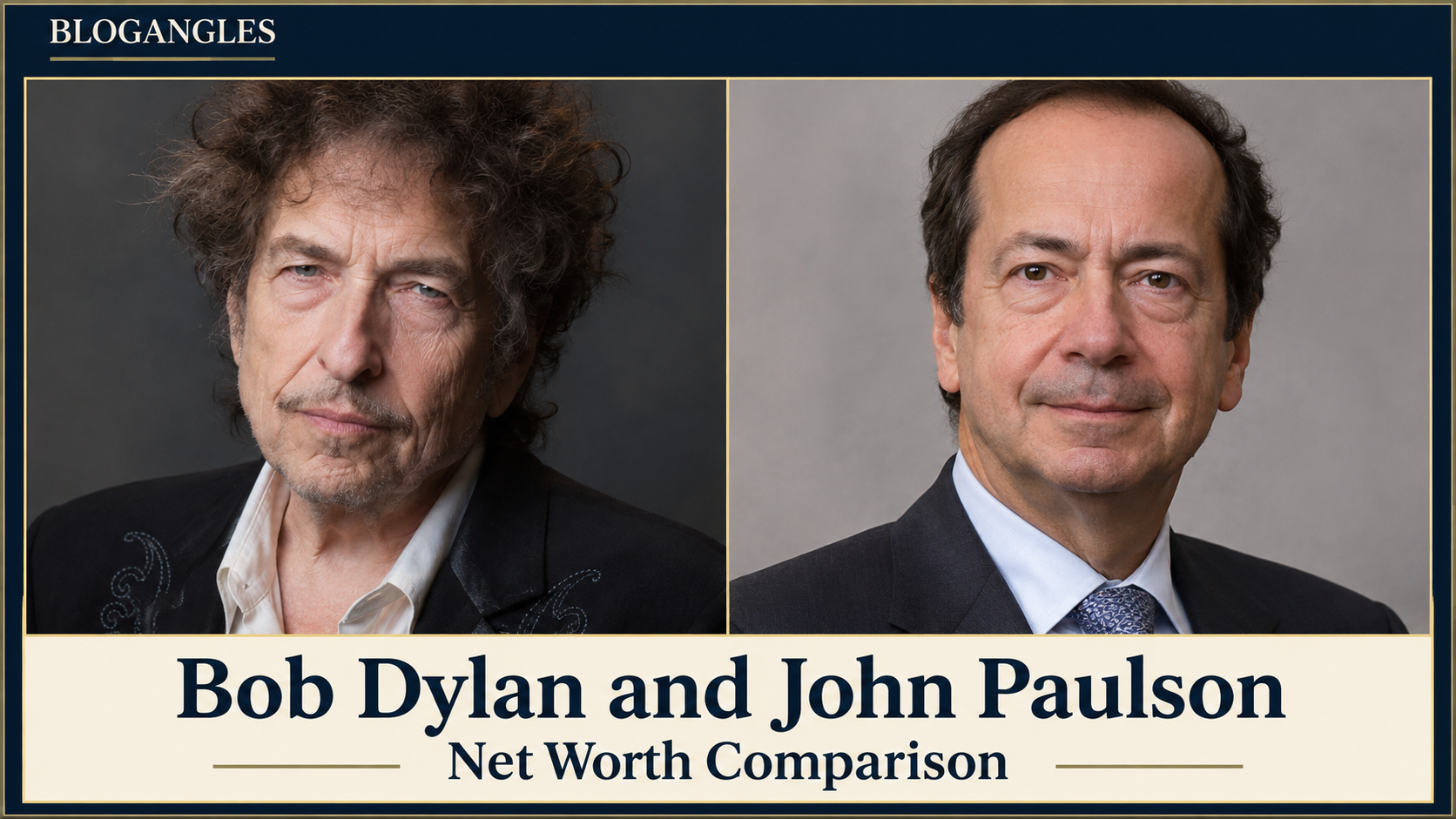
John Paulson is substantially wealthier than Bob Dylan according to the estimates reviewed for this Bob Dylan and John Paulson net worth comparison. Forbes put Paulson at about $11.2 billion on 11 November 2026, while Celebrity Net Worth estimates Dylan’s fortune at $500 million. The comparison is between an investor’s accumulated capital and a songwriter’s commercially valuable creative career.
The central story is not simply a difference in earnings. Dylan turned songs and recordings into assets that could be sold. Paulson built wealth through investments and an investment-management business. Understanding what each person owned is more informative than comparing the popularity of their names.
The Estimated Gap, in the Same Currency
Celebrity Net Worth’s Dylan estimate is an editorial assessment rather than a disclosed personal balance sheet. Forbes’ Paulson estimate is a dated billionaire valuation. Putting them side by side provides an approximate financial scale, but the sources do not offer identical access to their subjects’ finances.
On those figures, Paulson is estimated to be worth about 22.4 times as much as Dylan. The arithmetic difference is around $10.7 billion. A ratio should not imply that every underlying asset has been inspected or that the numbers would remain unchanged if calculated on another date.
There is also a timing issue. The date of a rights sale, the date a payment is received and the date of a wealth estimate can all differ. Adding transactions from several years to a current fortune without checking what the estimate already includes would risk counting the same economic value twice.
Dylan’s Two Catalogues Explain Why Rights Matter
In December 2020, Universal Music Publishing Group announced its acquisition of Dylan’s songwriting catalogue, covering more than 600 copyrights. The important word is songwriting. A musical composition is distinct from a particular recorded performance of that composition.
Sony then announced its acquisition of Dylan’s recorded-music catalogue in January 2022. These were separate transactions involving different rights. The announcements establish that the deals happened, but they do not provide a complete accounting of Dylan’s personal after-tax proceeds.
Ownership of a composition can generate licensing and royalty income when the work is used under relevant agreements. Ownership of a recording involves another set of commercial rights. That distinction explains how a musician can create valuable assets that extend beyond live performances or the sale of a physical album.
A catalogue sale exchanges some future economic interest for an agreed transaction value. It can make wealth more liquid, but it does not mean that the seller’s fortune rises by the full headline price on top of the value already attributed to the catalogue. Before the sale, those rights may already have been an asset in an outside estimate.
For Dylan, the confirmed transactions provide stronger evidence of a valuable creative business than an unsupported list of annual royalties. The precise division between retained rights, new work, cash, investments and other property remains outside the information established by the announcements.
Paulson’s Investment Ownership Operates on Another Scale
Paulson’s public financial profile centres on investment capital. Forbes associates his fortune with the firm he founded in 1994 and his successful position against subprime mortgages. Those facts explain the broad source of wealth, but neither a successful strategy nor a famous trade provides a complete record of every later gain or loss.
Investment returns can compound when capital stays invested. A larger capital base can produce a large monetary change from a relatively modest percentage movement. That mechanism differs from selling another concert ticket or negotiating a fee for a new recording, even though both involve commercial judgement and risk.
It is important to separate Paulson’s personal assets from money historically managed for outside clients. An investment manager does not personally own every asset managed by the firm. The firm’s business value, fee income and an owner’s invested capital are connected concepts, but they cannot simply be added together without examining overlap.
Forbes reports that Paulson moved the firm towards a family-office structure in 2020. That provides organisational context, not a public inventory of household assets. The estimate should therefore remain attributed rather than presented as a number confirmed by Paulson’s accountants.
What a Catalogue Sale Can Teach About Net Worth
Imagine a songwriter owns rights valued at $10 million and sells those rights for $10 million. Ignoring costs and tax solely for this example, the transaction changes the form of the asset from rights to cash. It does not automatically create a further $10 million on top of the previously owned rights. Keeping both amounts in the calculation would double count the same asset.
The same logic applies outside music. When an investor sells a holding, sale proceeds replace ownership of that holding. A reader needs the original purchase cost to calculate a gain and additional information to determine after-tax retained proceeds. Headlines about transaction size often omit those distinctions.
This does not reduce the significance of Dylan’s achievements or Paulson’s investment success. It makes the comparison more precise. Dylan’s creative legacy and Paulson’s capital base are different kinds of economic accomplishment, and neither can be reduced to one year’s reported income.
BlogAngles’ comparison of Malcolm Gladwell and Olivia Rodrigo offers another look at creative careers. Its John Paulson and Ola Källenius feature examines an investor alongside a corporate leader. These articles provide context without establishing any relationship between Dylan and Paulson.
The Financial Difference Between Writing and Recording
A listener may encounter one song through streaming, a cover version, a television programme or a live performance. Those uses do not necessarily pay the same rights holder. A recording agreement, publishing agreement and public-performance licence can each allocate money differently. That is why a confirmed catalogue acquisition is more informative than guessing a royalty from a song’s popularity. The ownership and contract determine the entitlement, rather than the number of times a title appears in public discussion.
For Dylan, the two acquisition announcements identify different commercial assets. They do not establish that every dollar mentioned in a press report was paid personally to him without deductions. For Paulson, the equivalent question is which investments belong to him and which belong to clients or separate entities. Both sides of the comparison ultimately require an ownership map. Readers can use that principle to evaluate future stories: identify the asset, identify the owner, identify the date, and only then examine the estimated value.
All monetary comparisons above use US dollars. Currency conversion would introduce another date-sensitive assumption, particularly when assets or earnings arise in other countries. Keeping one currency makes the published estimates easier to compare without suggesting that exchange-rate movements have been separately measured in either person’s private portfolio.
Questions About Bob Dylan and John Paulson’s Wealth
Who has the higher estimated net worth? John Paulson. The reviewed figures are approximately $11.2 billion for Paulson and $500 million for Dylan, so the published estimates are on very different scales.
Did Dylan sell both songs and recordings? Yes. Universal’s 2020 announcement concerns songwriting copyrights, while Sony’s January 2022 announcement concerns recorded music. These are distinct rights rather than two descriptions of one identical asset.
Are catalogue sale prices the same as Dylan’s net worth? No. Transaction values, taxes, ownership shares, retained assets and other liabilities all matter. A single sale does not establish an entire personal balance sheet.
Is Paulson’s estimate a cash balance? No. A billionaire estimate can include investments and other assets that are not held as cash. Their valuation can change without a sale.
Is there a documented joint venture between them? The sources used here do not establish one. This article compares separately documented careers and does not imply collaboration or a personal connection.
