

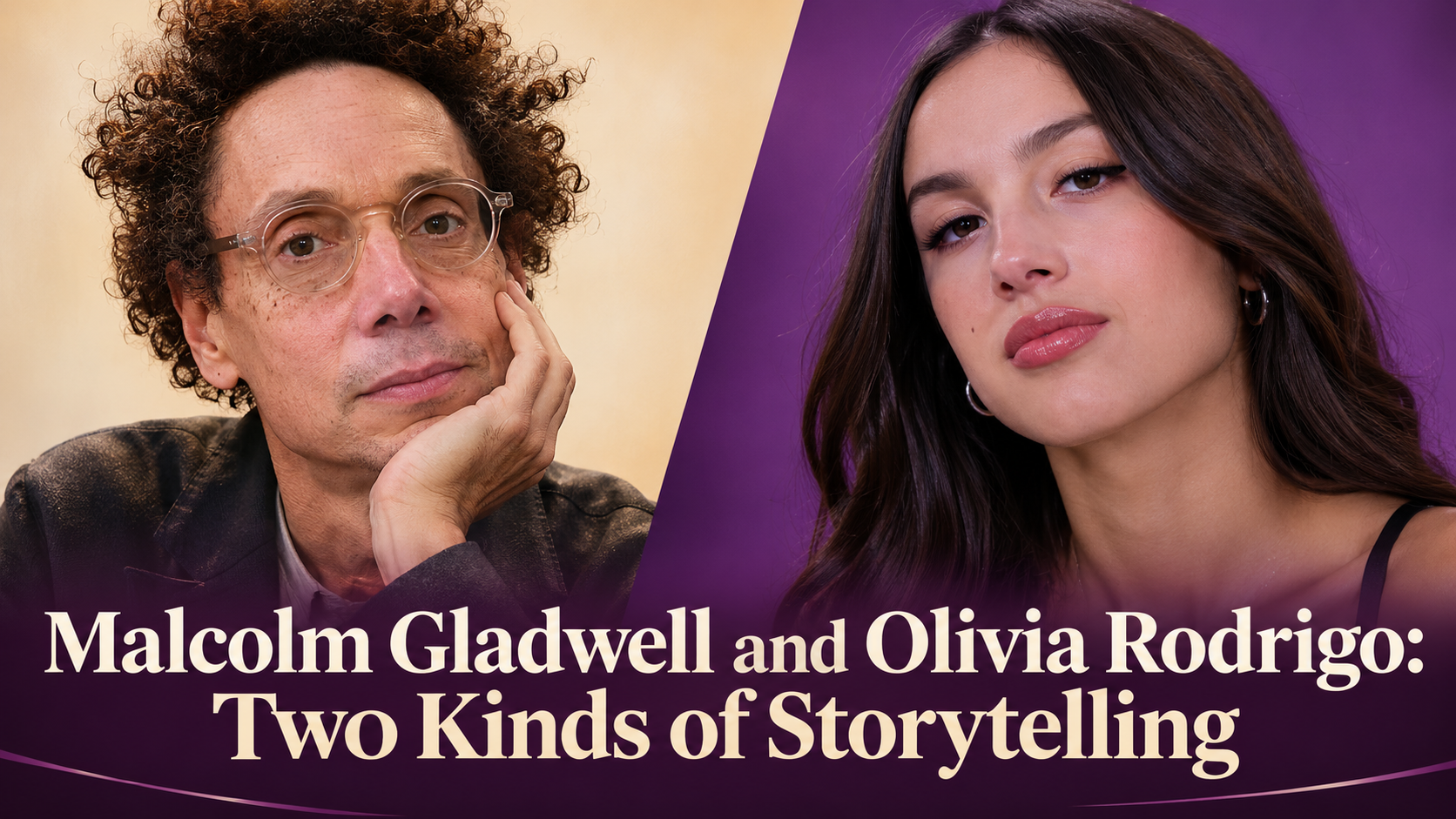
Malcolm Gladwell and Olivia Rodrigo work in different corners of popular culture: Gladwell explains ideas through nonfiction and audio, while Rodrigo expresses experience through songwriting and performance. The useful comparison is how they turn a recognisable observation into a story that an audience wants to revisit, rather than an assumed personal connection between them.
Their names together do not establish a collaboration, family relationship or shared business. The sources examined for this article document separate careers. Looking closely at those careers offers a more interesting answer than treating a paired search phrase as evidence of a hidden relationship: both depend on voice, structure and audience trust, but their work makes very different promises to the listener.
Malcolm Gladwell and Olivia Rodrigo at a glance
Gladwell is a journalist, author and podcast host associated with explanatory storytelling. Rodrigo is a singer, songwriter and actor whose recordings brought her a major international audience. A book chapter and a pop song can both be memorable narratives, although the standards used to judge their truth are different.
A useful starting point is to ask what each person is asking an audience to believe. Nonfiction offers an account of the world that can be tested against evidence. A song can draw on experience without functioning as a literal report of every event it describes. Confusing those forms makes both artists harder to understand and encourages unnecessary speculation about private lives.
Gladwell’s craft: making an explanation feel like a discovery
Gladwell’s official website identifies him with books including The Tipping Point, Blink and Outliers, as well as the audio company Pushkin Industries. Those reference points explain why he is associated with stories about behaviour, judgement and social change. They also show that his public work extends beyond a single book or medium.
The central attraction of explanatory writing is the movement from a specific situation to a broader question. A reader encounters a person, an incident or an apparent puzzle, then follows an argument about why it matters. The story gives a difficult idea a human scale. The explanation gives the story a reason to travel beyond the people immediately involved.
That technique is powerful, but it places a particular responsibility on the author and the reader. A memorable example is not automatically representative of a population. An elegant explanation may need qualifications, alternative explanations or additional evidence. Readers get more from narrative nonfiction when they separate the vividness of an anecdote from the strength of the argument it illustrates.
Why the audio format matters
A spoken narrative can make pauses, uncertainty and changes of emphasis audible. The listener hears a person guide the argument rather than seeing only paragraphs on a page. Gladwell’s association with podcasts therefore matters to this comparison: it brings his explanatory work into a medium that, like recorded music, depends on the experience of listening over time.
That similarity should not be pushed too far. An interview, a reported podcast and a studio recording involve different production decisions and different kinds of accountability. What they share is the need to hold attention without losing the listener’s sense of direction. A strong opening creates interest; the later material must justify the time invested in it.
Rodrigo’s craft: making a feeling specific
Rodrigo’s recording career can be checked through the Recording Academy’s artist record. Her 2022 Grammy recognition included Best New Artist, Best Pop Vocal Album for Sour and Best Pop Solo Performance for “Drivers License”. Those are documented musical achievements, rather than estimates of wealth or measures of social-media popularity.
A songwriter works with far less explanatory space than a nonfiction author. A verse needs to establish a situation quickly, and a chorus needs to carry an idea that remains meaningful when repeated. Details become important because a precise image or a shift in perspective can suggest a larger emotional situation without a long account of its background.
The listener also has an active role. A song can feel personal because it leaves enough room for someone else to recognise their own experience in it. That does not mean every listener has lived the same event or that the singer is offering a complete account of a private relationship. Emotional recognition and biographical verification are different things.
Why interpretation needs boundaries
Public interest in an artist often moves from the work to the presumed people behind it. Sometimes an artist explains the origin of a song directly; sometimes the work remains open to interpretation. Responsible coverage distinguishes those situations. A fan theory can be discussed as a theory, but it should not be upgraded into a factual claim about another person.
This boundary protects the usefulness of criticism as well as personal privacy. Instead of reducing a song to a guessing game, a reviewer can examine its structure, perspective, musical choices and emotional effect. Those are features the listener can actually assess. They provide a firmer basis for discussion than an unsupported account of what happened outside the recording studio.
What connects their storytelling methods?
The strongest connection is analytical: both can be understood through selection, sequencing and voice. A nonfiction writer chooses which examples to develop and when to reveal information. A songwriter chooses which images and musical moments to repeat. In both cases, leaving something out is part of the craft, because a story cannot give equal weight to every possible detail.
Sequencing changes meaning. An observation presented before an explanation can create curiosity; presented afterwards, it may function as confirmation. In music, a repeated phrase can feel different after a later verse changes the listener’s understanding. The audience experiences a work in an order, and that order influences what it notices, expects and remembers.
Voice provides continuity across those changes. It can mean the recognisable perspective of an author as well as the sound of a singer. Audiences often return because they value that perspective, although familiarity should not replace judgement. Readers can admire an author’s clarity while questioning a conclusion, just as listeners can appreciate a performance without treating every lyric as autobiography.
Success cannot be reduced to one scoreboard
Sales, awards, reviews, touring demand and cultural discussion describe different aspects of a career. They are not interchangeable units. A literary reputation cannot be ranked against a recording award by simply counting honours, and a large audience does not settle whether an argument is convincing or a song is effective.
The same caution applies to financial comparisons. Book revenue, recording income, performance fees and company ownership can be reported in different ways. Gross sales are not personal earnings, and earnings are not net worth. Without a transparent account of assets, liabilities, ownership and timing, a precise wealth ranking would create an appearance of certainty that the available evidence does not support.
How to explore their work thoughtfully
For Gladwell, begin with a complete piece rather than an isolated quotation. Identify its main claim, notice which evidence supports it, and ask whether the conclusion is broader than the examples justify. For Rodrigo, listen to a complete recording or album and consider the relationship between words, melody and performance before looking for explanations outside the work.
Online discussion can add context, but the venue matters. BlogAngles’ guides to r/Popheads and music-fandom discussion on Reddit provide related background on how audiences discuss popular music. Community interpretation is useful as a record of audience response; it does not replace an artist’s own statements or independently verified reporting.
Frequently asked questions
Have Malcolm Gladwell and Olivia Rodrigo collaborated?
The sources reviewed here do not establish a collaboration between them. This article compares their documented public work and does not imply that they have released a joint project.
What is Malcolm Gladwell known for?
He is known for narrative nonfiction and audio storytelling, including books such as The Tipping Point and Outliers. His official website also identifies his involvement with Pushkin Industries.
What did Olivia Rodrigo win at the 2022 Grammys?
She won Best New Artist, Best Pop Vocal Album for Sour and Best Pop Solo Performance for “Drivers License”. The Recording Academy’s records are the appropriate source for those awards.
Are songs the same kind of evidence as nonfiction?
No. A nonfiction argument makes claims that can be checked against reporting and research. A song can convey a perspective or emotional experience without offering a literal, comprehensive account of real events.
Who is more successful?
That depends on the measure. Their careers operate in different industries, so a useful comparison specifies whether it concerns audience reach, artistic achievement, commercial activity or the craft of storytelling.
